
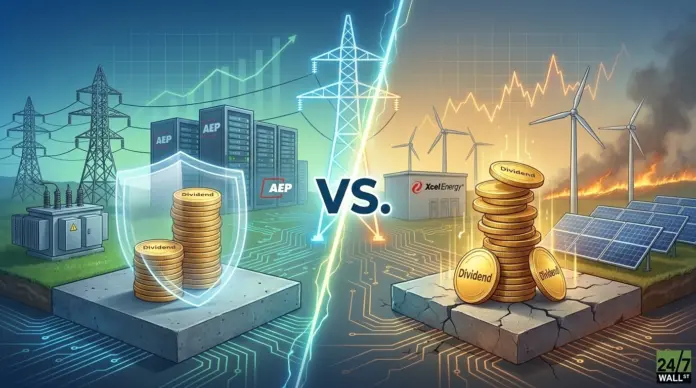
Both utilities are chasing the same data center boom and paying nearly identical dividends, but one carries a risk that could quietly drain cash away from shareholders before the next raise ever arrives.
American Electric Power (NASDAQ:AEP | AEP Price Prediction) or Xcel Energy (NASDAQ:XEL): which one better fits an income portfolio built for retirement? Both regulated utilities are seeing new demand from data centers, both yield about 3%, and both point to earnings growth. The split comes in what could put the payout at risk.
Over the past year, AEP gained 14.82% to $130.60. Xcel rose just 1.34% to $78.91.
Income Today: Xcel Pays a Little More
Xcel yields 3.03%. AEP yields 2.97%. Xcel’s latest raise took the quarterly dividend from $0.57 to $0.5925, an increase of about 3.9%, and management targets annual increases of 4%–6%. AEP declared its newest dividend on October 20, lifting the quarterly payout from $0.95 to $0.97. That’s about 2.1%.
Coverage also shifts toward Xcel. Measured against the midpoint of 2026 guidance, Xcel’s dividend uses about 58% of earnings, a bit above its own 45%–55% target. AEP’s $3.88 annualized payout uses about 61%. Both companies have long records of raising their dividends. Since 2021, AEP’s quarterly dividend has grown about 31%, while Xcel’s has grown about 30%. Winner: Xcel, by a thin margin.
Growth Trajectory: AEP’s Contracted Load Sets It Apart
AEP’s five-year capital plan is $78 billion, which should drive nearly 11% annual rate base growth. It now has 69 gigawatts of contracted load additions through 2030, up from 63 a quarter earlier, and 45 gigawatts of that is in Texas. The CFO said: “Importantly, our $78 billion capital plan does not anticipate this magnitude of load growth.” AEP also raised its 2026 operating EPS guidance to $6.25–$6.55.
Xcel kept its 2026 guidance at $4.04–$4.16 and is targeting 6% to 8-plus percent long-term growth. Its data center business is smaller: 1 gigawatt in operation or under construction and another 1 gigawatt under signed agreements. Its base plan includes very little data center growth. AEP trades at about 20x forward guidance and Xcel at about 19x, a small premium for a much larger pipeline already under contract. Winner: AEP.
Risk: Xcel’s Wildfire Costs Keep Growing
Xcel estimates total losses and costs from the Smokehouse Creek fire at $503M, with only about $80M of insurance coverage left, and the Texas Attorney General has sued its SPS subsidiary. Marshall Wildfire settlements add up to $640M. Debt is $37B, or 61% of total capitalization, and Moody’s has a negative outlook on Xcel’s unsecured debt. Interest charges rose $174M in the first half of 2026.
AEP has disclosed no major wildfire settlements. Its biggest regulatory problems are partial cost disallowances in Texas. Management is holding to a funds-from-operations-to-debt target of 14% to 15%, and a $3 billion forward equity sale covers all the new equity it expects to need for the current plan. Winner: AEP, clearly.
Verdict: AEP’s Dividend Is Built to Last
AEP’s dividend looks better protected for retirees who need their income to hold up. Xcel’s yield is slightly higher, but it has uninsured wildfire costs, a negative credit outlook, and rising interest expense, all of which compete with shareholders for cash. AEP gives up a few basis points of yield in exchange for contracted growth and a cleaner balance sheet. Xcel fits income investors who want faster near-term dividend increases and are willing to accept wildfire litigation risk to get them. Retirees hunting for payouts with the longest track records can see how we rated ten of them by valuation in a free Dividend Kings report.
Next, look at the third-quarter earnings calls. AEP will present a revised five-year plan for 2027 through 2031, and Xcel will give an updated capital and financing plan. Those reports will show how much of each company’s data center demand turns into rate base growth.
Contact [email protected] for any questions or corrections.
Source: 247wallst.com — article syndicated from the publisher’s feed; all rights remain with the original publisher.

