
There was an abundance of good news in the third-quarter earnings report for midstream energy company Kinder Morgan (KMI -0.31%). The company hiked its dividend by 2%, earnings per share (EPS) rose 21% year over year to $0.34, and adjusted earnings before interest, taxes, depreciation, and amortization (EBITDA) climbed by 9% over the same period a year ago.
The report is a big reason why the stock jumped 1.6% on Oct. 21, the day it reported earnings. Hidden among all that information is something that trumps everything else in the report.
Image source: Getty Images.
It’s all about the backlog
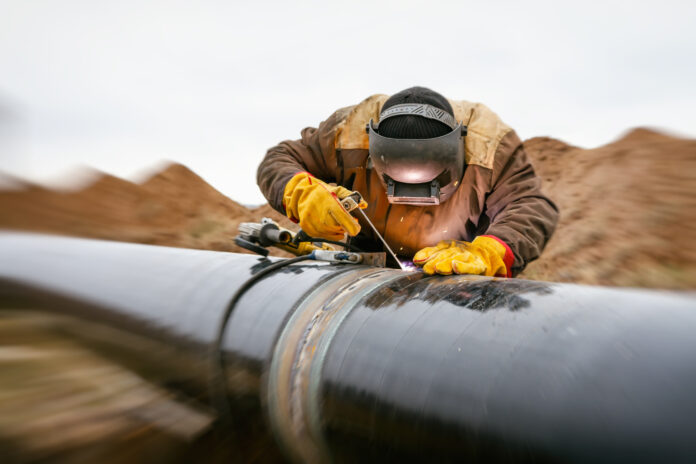
Kinder Morgan already transports 40% of the natural gas in this country through its more than 65,000 miles of pipelines, and it is still growing. The company reported a third-quarter backlog of $14.4 billion in expansion projects, including a company record of $13.2 billion in natural gas projects. That’s a jump from $9.6 billion in the prior quarter.
The extra $5.4 billion in new projects includes the company’s Southern Natural Gas Company’s Southeast Connector and the Permian Link for the Natural Gas Company of America. Both projects are designed to transport more than 2.5 billion cubic feet per day of natural gas, two of the largest natural gas pipelines in decades.
It means great long-term revenue visibility
The most important structural element of Kinder Morgan’s backlog is how the future revenue is secured. Major additions to the backlog, such as the Permian Link and SNG’s Southeast Connector, are supported by long-term take-or-pay contracts spanning up to 20 years with credit-worthy counterparties, including electric utilities, liquefied natural gas (LNG) exporters, and hyperscalers.
Under a take-or-pay structure, customers are legally obligated to pay for pipeline capacity regardless of whether they actually run natural gas through it. These highly predictable cash flows insulate Kinder Morgan from fluctuations in underlying commodity prices or short-term variations in throughput.
They also provide an obvious path to EBITDA growth. Management suggested that the backlog, once completed, will produce roughly $2.5 billion in additional adjusted EBITDA, meaning the company’s base adjusted EBITDA would jump to the $11.5 billion to $12 billion range, representing at least a 37% increase over 2025.
KMI – Kinder Morgan
$33.84-$0.11 (-0.31%)
NYSE · As of 3:09 PM ET 10/27/26
The company is seeing significant tailwinds
Thanks to new capacity commitments from AI data centers and hyperscalers, Kinder Morgan is seeing increased demand for its pipelines. That explains why the company can continue to raise its dividend while funding capital improvements without taking on additional debt.
That dividend is a great reason to hold on to the stock. It has yield of 3.47% at its current share price, and Kinder Morgan has increased that dividend by 138% over the past 10 years. Meanwhile, Kinder Morgan expects to fund a capital expenditure run rate of roughly $4 billion annually over the next few years to construct these assets.
Because the assets are self-funded while maintaining a healthy leverage profile (around 4.5x debt-to-EBITDA), the incremental cash flows generated as projects come online in phases, from late 2026 through 2030. That means Kinder Morgan can easily forecast the likely benefits of its pipeline expansion.
Source: www.fool.com — article syndicated from the publisher’s feed; all rights remain with the original publisher.

