
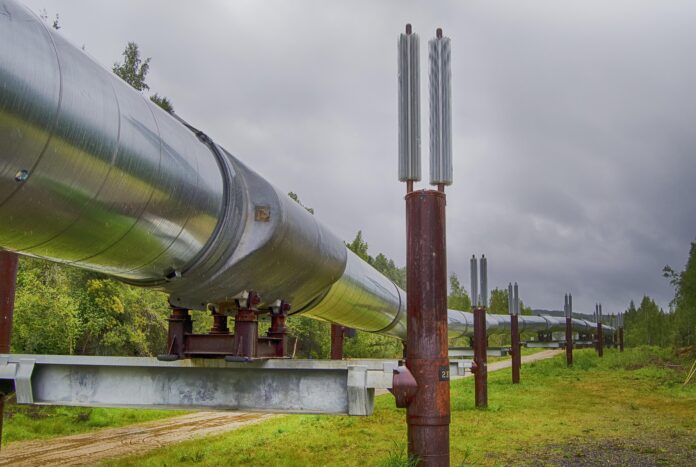
LNG isn’t my home turf — I’ve spent my career on jet engines and airframes — but a production ramp is a production ramp, and I know leverage when I see it. Venture Global (VG) has delivered the kind of execution that earns respect: the stock returned 48.0% over the past year against 15.1% for the S&P 500, and revenue over the latest twelve months doubled. Its Plaquemines facility is scheduled to reach commercial operation in the fourth quarter of 2026, with CP2 following in 2027. Yet management flagged one risk outside its control on the August 11, 2026 earnings call, and it’s the kind of risk that separates businesses you can model from businesses you can only bet on.
**The Warning: LNG Price Swings**
Management pointed to outsized swings in LNG prices tied to Middle East events as the reason for a wider-than-usual guidance range. Venture Global sells a portion of its output at market prices rather than under long-term contracts, so its earnings track those swings directly. In an engineering life, I learned to distrust any system whose performance depends entirely on an input you don’t control. Same logic applies here.
The near-term picture has actually improved. The company raised its 2026 guidance for adjusted EBITDA to $8.7–$9.1 billion, up from $8.2–$8.5 billion. That guidance assumes a market liquefaction fee of $12.50–$13.50 per MMBtu on cargoes not yet sold. That fee is what Venture Global earns for converting gas into LNG — and every cargo priced below that mark drags earnings below plan.
**What Fee Declines Would Cost**
For the remainder of 2026, exposure is modest. As of the August call, more than 91% of the 2026 portfolio was contracted, up from 84% in May. Management quantified it: every $1 per MMBtu change in fees moves the adjusted EBITDA range by $180–$210 million.
2027 is a different animal. A $1 change in fees translates to $650–$700 million of adjusted EBITDA, per management. The company also has 32 million tonnes per year of capacity still to market, from excess capacity plus bolt-on expansions at CP2 and Plaquemines Phase 1. Management says it will still sign some 20-year contracts but is shifting toward shorter deals at higher prices. Shorter contracts mean higher spot capture today and less revenue visibility tomorrow — a deliberate trade of certainty for margin.
**Valuation vs. Reality**
Despite that 2027 exposure, you aren’t paying much for current profit. The stock traded at 25.3 times earnings on June 30, 2025, and 7.7 times a year later; it now sits at 9.7 times versus 22.9 for the S&P 500. The market is plainly pricing in the assumption that today’s earnings are partially unsustainable. That skepticism may be warranted, but it isn’t the whole story.
The multiple doesn’t capture spending. Free cash flow was negative $6.99 billion over the twelve months to June 30, 2026, and total debt stood at $42.5 billion — 122% of market value at the latest close, versus 19.4% for the S&P 500. If fees fall in 2027, earnings compress while the debt stays put. Any investor who has watched a program carry fixed costs through a revenue shortfall knows how quickly that arithmetic turns ugly.
**How Much to Worry**
The risk is real but timed: it lives in 2027, while most of the rest of 2026 is already under contract. The figures that matter in the November 10, 2026 report are the assumed liquefaction fee on unsold cargoes and the percentage of 2027 output contracted. Track those two numbers and the investment thesis largely writes itself.
Construction progress and contract coverage are things management can control; LNG prices are not. In this business, you put your money on the former and size your position for the latter.

