
Key Takeaways
- Oklo fell 6% today along with Comfort Systems USA, Quanta Services and EMCOR after Democrats were projected to win Congress.
- Oklo has almost no revenue, so a threat to data-center building hits it harder than contractors with record backlogs.
- Oklo pays for its reactors by selling stock, so a lower share price makes that money more expensive.
- NuScale Power reports on Nov. 5 and Oklo on Nov. 6.
Oklo (OKLO) fell 6% today on no news of its own, as investors dumped AI power stocks after Tuesday’s midterms.
Democrats were projected to take the House and the Senate. Texas elected Gina Hinojosa as governor, and she campaigned on a stricter data-center moratorium. Builders took the worst of it: Comfort Systems USA (FIX) dropped 15%, Quanta Services (PWR) fell 12% and EMCOR Group (EME) lost 9%. Fellow reactor developer NuScale Power (SMR) fell 4%, while the S&P 500 rose 2%.
KeyBanc’s Sophie Karp downgraded Vistra to Sector Weight, saying a Democratic sweep in Texas will “come as a negative surprise to investors.”
Oklo has no revenue to fall back on
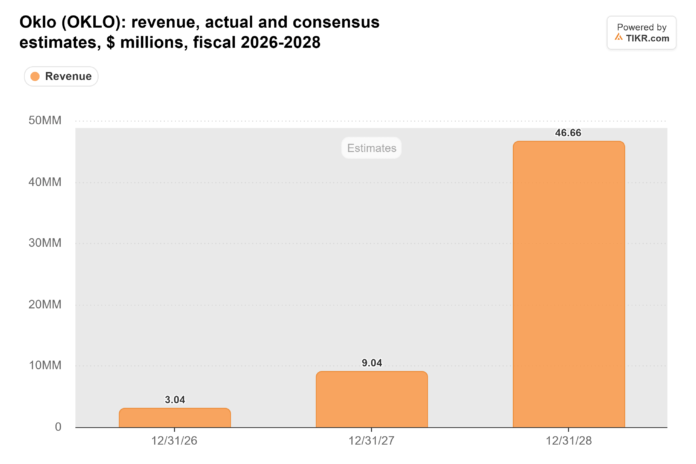
Vistra’s plants already earn money. Oklo is still building its first, and as of November 2025, most of its pipeline of about 14 gigawatts was data centers. Analysts expect just $3.04 million of revenue this year:
Oklo (OKLO): revenue, actual and consensus estimates, $ millions, fiscal 2026-2028 (TIKR)
There’s not much there for analysts to cut. The worry is demand years from now, and that’s what the stock is priced on: 596x next-twelve-months sales at Tuesday’s close.
NuScale hasn’t sold a reactor yet either, but its big U.S. prospect is a utility: its partner ENTRA1 is negotiating a power deal with the Tennessee Valley Authority. Does a data-center backlash reach that order? NuScale’s Nov. 5 report should tell us more.
TIKR tracks 25 analysts on Oklo. How many say “Buy”?
See the full breakdown of Buy, Hold, and Sell ratings on Oklo, along with Wall Street’s revenue and earnings estimates, all in one place. More than 500,000 investors use TIKR to research stocks like this one. See Oklo’s Analyst Ratings
Oklo pays its way in stock
Shareholders pay for Oklo’s build. Its cash grew to $788 million by the end of 2025:
Oklo (OKLO): cash and equivalents, $ millions, fiscal 2021-2025 (TIKR)
Cash and securities reached $3.0 billion by June 30, 2026. Analysts expect Oklo to burn $6.3 billion of free cash flow from 2026 through 2030. Its stock sales averaged $63.51 a share in the second quarter, down from $96.95 in January, and the stock just hit a new 52-week low. Every drop like today’s means selling more shares to raise the same money.
The contractors have signed work
Comfort Systems ended September with $17.81 billion of backlog, more than $8.0 billion above a year earlier. EMCOR’s remaining performance obligations hit a record $18.57 billion, up 47.2%. Quanta faces the same question as both: will customers pause that work if new data-center rules arrive?
The selling fits Oklo best
Here’s where I land: Oklo has the least cushion on today’s list, since a lower stock price raises its funding costs before anyone writes a new law.
Of course, a campaign promise isn’t a law. Oklo’s third-quarter report, before the open on Nov. 6, should show us where its cash stands.
So what is Oklo stock actually worth?
TIKR lets you forecast the future price of any stock in less than a minute. Just enter a few assumptions into TIKR’s valuation model and see what Oklo could be worth. Start from Wall Street consensus estimates, or adjust the inputs to reflect your own view of the business. It’s free to use.
Disclaimer:
Please note that the articles on TIKR are not intended to serve as investment or financial advice from TIKR or our content team, nor are they recommendations to buy or sell any stocks. We create our content based on TIKR Terminal’s investment data and analysts’ estimates. Our analysis might not include recent company news or important updates. TIKR has no position in any of the stocks mentioned. Thank you for reading, and happy investing!
Source: www.tikr.com — article syndicated from the publisher’s feed; all rights remain with the original publisher.

