
Polar Vortex Puts Europe’s Gas Reserves at Risk | OilPrice.com
ZeroHedge
The leading economics blog online covering financial issues, geopolitics and trading.
Trending Discussions
Premium Content
By ZeroHedge – Nov 04, 2026, 1:00 PM CST
The European Center for Medium-Range Weather Forecasts shows signs of an early disruption of the Arctic polar vortex that could send cold air into Northwest Europe as the energy-stricken continent faces a very thin supply buffer before the Northern Hemisphere winter gathers pace.
We are officially in uncharted territory. The Polar Vortex is currently the weakest it’s ever been for the date and is headed for the crucial 0 line over the next day or so. If it gets to a value of 0 or lower, it will officially be the earliest Sudden Stratospheric Warming Event on record. Regardless of the technical details, the current forecasts show the Polar Vortex remaining record breakingly weak for an extended period of time… in fact, it is not exactly clear when or how much the Polar Vortex will recover… this is a critical detail when it comes to pinpointing the impacts from this. What I can say is that the longer this goes on and remains weak, the higher the odds for a snowy winter. Remember, this disruption is about to begin in the stratosphere but we won’t see the effects make it to our part of the world for 1-4 weeks. This means we will likely see a dramatic change in the weather pattern as we move from November into December. I’ll have more details on this and many other factors in my Winter Forecast that will be coming out soon! #winteriscoming
— Mark Margavage (@MeteoMark) November 3, 2026
One week ago, we reported that signs of a potentially record-early sudden stratospheric warming were developing and that a split in the vortex could send Arctic air into the northern US and/or parts of Europe within weeks.
ADVERTISEMENT
Knockout blow. An absolutely textbook heat flux punch upwards from the troposphere into the stratosphere triggering a collapse of the stratospheric vortex and a reversal of westerlies to easterlies, a major and likely record early major sudden stratospheric warming ???????? https://t.co/Xtohsr6SmN
— Met4Cast – UK Weather (@Met4CastUK) November 2, 2026
BloombergNEF reports that one week of Arctic air could send heating demand soaring in Europe and wipe out any natural gas storage gains made during October’s mild weather.
If temperatures average 5C below the 10-year normal in the first week of December, heating demand across Northwest Europe, Italy, Spain and Austria would soar by about 1.1 billion cubic meters.
Here’s more from the report:
A week of materially colder weather could quickly erode Europe’s already thin gas storage buffer.
ADVERTISEMENT
If temperatures across Europe averaged 5°C below the 10-year normal over Dec. 2-8, heating demand across the BNEF Europe Perimeter (Northwest Europe, Italy, Spain and Austria) would rise by around 1.1 billion cubic meters.
And if that additional demand were met entirely from storage, end-March inventories would fall to about 15.5% full, from around 17% under average weather. That would leave stocks only around half a percentage point above BNEF’s estimated minimum, the end-March level below which Europe would begin drawing on gas assumed to be held as strategic reserves rather than normal commercial inventories.
October’s mild weather helped Europe build a larger-than-expected cushion heading into winter. Lower heating demand allowed injections to continue later into the season, leaving storage additions around 1 Bcm above the 2021-25 October average.
Europe is entering the cold period with NatGas inventories at their lowest seasonal level since the 2022 energy crisis, at around 74% of capacity. This means the buffers that shield the continent from demand shocks will draw down to dangerously low levels by March.
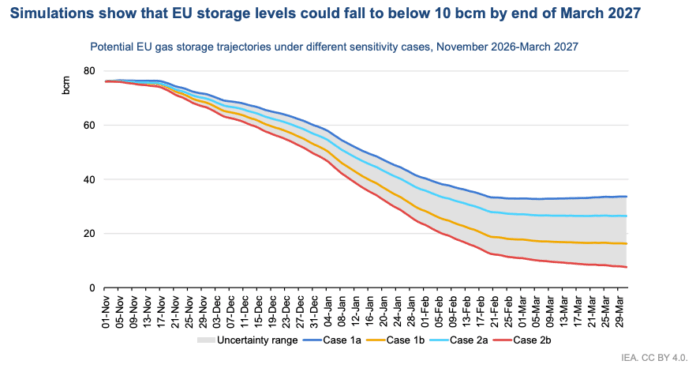
On Tuesday, the International Energy Agency released a new report warning of just that, citing a “reduced buffer against supply disruptions” and forecasting that NatGas storage levels on the continent could drop below 10% by late March.
“This would leave the European market particularly exposed to events, whether additional cold snaps, technical outages or other supply disruptions, since the rate at which gas can be withdrawn from storage sites tends to decline once fill levels fall below 30% of working capacity,” the IEA wrote in the report.
As we noted, energy markets in the US and Europe differ starkly: EU NatGas futures trade at roughly 11 times US NatGas prices.
Europe is just a couple of cold snaps away from a deepening energy crisis that will keep EU NatGas prices elevated well into next spring.
By Zerohedge.com
More Top Reads From Oilprice.com
Download The Free Oilprice App Today
Trending Discussions
–>
ZeroHedge
The leading economics blog online covering financial issues, geopolitics and trading.
Related posts
“
Source: oilprice.com — article syndicated from the publisher’s feed; all rights remain with the original publisher.

