
Key Takeaways
- Verizon yields 6.1% and Duke Energy yields 3.5%, and each raised its dividend 2% a year from fiscal 2020 to fiscal 2025.
- Verizon’s dividend took 52% of its free cash flow over the last twelve months, and Duke’s took 67% of its fiscal 2025 normalized EPS, the measure that fits a regulated utility.
- Duke carries more debt, at 5.4x net debt to EBITDA against 3.3x for Verizon, while it builds new capacity for data centers.
- SpaceX’s plan to become a wireless carrier is the main long-term risk to the cash flow behind Verizon’s dividend.
Verizon (VZ) shareholders had a rough October. The stock fell about 9% on Oct. 9 after SpaceX agreed to buy a nationwide block of low-band spectrum for its Starlink Mobile service.
Duke Energy (DUK) has had a calmer fall. On Nov. 5, it reported third-quarter adjusted EPS of $1.99, up from $1.81 a year before, and said it’s on track to finish 2026 near the top of its guidance.
So for a retiree who wants a check they can count on, which is the better buy: Verizon’s much bigger yield, or Duke’s steadier regulated growth?
MetricVerizon (VZ)Duke Energy (DUK)Dividend yield6.1%3.5%Dividend growth, fiscal 2020-20251.9% a year2.0% a yearCoverage measureCash dividend payout ratioPayout ratio of normalized EPSCoverage, last reported52% (TTM to Sept. 30, 2026)67% (fiscal 2025)Coverage, forward53% (fiscal 2026 consensus)65% (fiscal 2026 consensus)Net debt / EBITDA3.3×5.4xInterest coverage (EBIT / interest)4.3×2.4x
Source: TIKR and StockAnalysis, Nov. 5, 2026.
6 safe dividend stocks paying retirees 6%+ yields
There are over 100 stocks paying 6%+ annual dividends today.
But after an extensive investment review leveraging TIKR’s proprietary data, we now believe only six of them are truly safe for retirees.
They’re all yours for free as part of our new investment report, which you can access right here.
Verizon has cash to spare
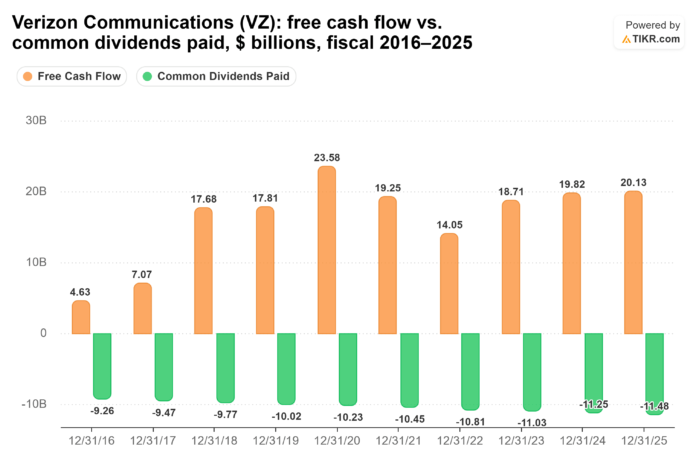
Verizon’s dividend took a well-covered 52% of its free cash flow over the twelve months to Sept. 30, 2026, and it would take 53% of what analysts expect for fiscal 2026. Free cash flow has topped the dividend every year since fiscal 2018:
Verizon Communications (VZ): free cash flow vs. common dividends paid, $ billions, fiscal 2016–2025 (TIKR)
Verizon added 406,000 postpaid phone customers in the third quarter of 2026, and mobility and broadband service revenue rose 2.9% from a year before, to $23.5 billion. It now expects free cash flow growth to approach 12% in 2026.
CEO Dan Schulman says the company is winning customers without heavy subsidies: “I don’t consider free lines to even be net adds. I think they’re churn waiting to happen.”
The risk is SpaceX. On SpaceX’s Oct. 20 call, President Gwynne Shotwell said it’s targeting service on its own airwaves in early 2028. SpaceX won’t dent Verizon’s cash flow this year, but it’s still a real long-term threat to the wireless business that pays the dividend.
Duke’s earnings are growing faster than its dividend
Where Verizon offers a bigger check, Duke Energy offers a predictable one. As a regulated utility, it’s judged on its payout ratio of normalized EPS: 67% for fiscal 2025, and 65% on fiscal 2026’s consensus. That ratio was 76.9% in fiscal 2018. Since then, normalized EPS has risen from $4.72 to $6.31 in fiscal 2025, and the dividend has gone from $3.63 to $4.22 a share:
Duke Energy (DUK): dividends per share vs. normalized EPS, $ per share, fiscal 2016–2025 (TIKR)
Management reaffirmed 5% to 7% annual adjusted EPS growth through 2030. Duke is building 16 gigawatts of new capacity by 2031 for data centers and other big customers. An Oct. 7 agreement in North Carolina would have data centers pay upfront for grid connections and for at least 75% of their projected power each month, if the state’s utilities commission approves it by mid-November.
The dividend isn’t keeping up with earnings, though. July’s 2% raise marked “over 20 years of consecutive annual dividend increases,” and management called it “consistent with growth in recent years.”
Duke is paying for the build-out largely with debt. Its net debt is 5.4x EBITDA, against Verizon’s 3.3x, and its EBIT covers its interest 2.4x, against 4.3x for Verizon.
So which dividend wins?
Verizon is the better dividend stock for retirees. Its 6.1% yield pays $607 a year on $10,000 today, against $350 at Duke’s 3.5%. At each company’s five-year dividend growth rate, Verizon would pay about $722 in year 10, a 7.2% yield on the original $10,000. Duke would pay about $419, and its income wouldn’t catch up with Verizon’s for more than 30 years.
Verizon pays that bigger check from just over half its free cash flow, with less debt behind it. And the stock trades at 8.7x forward earnings, just under its five-year average of 8.8x and well below its 10.5x high in March:
Verizon (VZ): forward (NTM) P/E, last 5 years (TIKR)
My read: the market has already priced in some of the SpaceX threat.
That isn’t to say Duke’s dividend is shaky. Its payout ratio is the lowest in at least a decade, its earnings growth is guided through 2030, and it has no SpaceX to worry about. It’s just that Verizon pays a much bigger check today, and it covers that check with plenty of room.
Of course, the FCC still has to approve SpaceX’s spectrum deal, and SpaceX’s own network is still years away. If Starlink Mobile starts winning over Verizon’s customers in 2028, I’d revisit this call.
Enjoy your retirement in style with these safe 6%+ dividend yields
Dividends can hold the key to enormous wealth. But only if you buy the right ones.
Picking the right high-yield dividend stock can be the difference between a dream retirement…and scraping by every month, waiting for the next Social Security check to clear.
We’ve identified six stocks yielding 6%+ that we believe every retiree should know about right now.
Disclaimer:
Please note that the articles on TIKR are not intended to serve as investment or financial advice from TIKR or our content team, nor are they recommendations to buy or sell any stocks. We create our content based on TIKR Terminal’s investment data and analysts’ estimates. Our analysis might not include recent company news or important updates. TIKR has no position in any of the stocks mentioned. Thank you for reading, and happy investing!
Source: www.tikr.com — article syndicated from the publisher’s feed; all rights remain with the original publisher.

