Energy demand is surging as data centers and artificial intelligence technologies strain the existing power grid. Deciding between Bloom Energy Corp (BE -2.03%) and NextEra Energy Inc (NEE -1.23%) requires weighing high-growth innovation against stable, utility-backed profitability.
Collapse
BE & NEE: Performance Comparison
Key Financial Metrics
BE – Bloom Energy
$289.77
–2.03% (-$6.01)
NEE – NextEra Energy
$76.93
–1.23% (-$0.96)
Market Cap
$87B
52wk Range
$75.70 – $351.28
Gross Margin
31.22%
P/E Ratio
403.02
EPS (TTM)
$0.73
Dividend & Yield
N/A
Market Cap
$162B
52wk Range
$74.41 – $98.75
Gross Margin
35.80%
P/E Ratio
17.47
EPS (TTM)
$4.46
Dividend & Yield
$2.44 (3.13%)
BE – Bloom Energy
$289.77
–2.03% (-$6.01)
Market Cap
$87B
52wk Range
$75.70 – $351.28
Gross Margin
31.22%
P/E Ratio
403.02
EPS (TTM)
$0.73
Dividend & Yield
N/A
NEE – NextEra Energy
$76.93
–1.23% (-$0.96)
Market Cap
$162B
52wk Range
$74.41 – $98.75
Gross Margin
35.80%
P/E Ratio
17.47
EPS (TTM)
$4.46
Dividend & Yield
$2.44 (3.13%)
Bloom Energy provides on-site solid oxide fuel cells, offering a decentralized alternative to traditional power grids for energy-intensive industries. NextEra Energy operates Florida’s largest regulated utility and is also a global leader in wind and solar power generation. These companies represent two different ways to invest in the future of the American power infrastructure.
The case for Bloom Energy
Bloom Energy manufactures solid oxide fuel cell systems that provide on-site electricity and hydrogen for high-demand environments. The company focuses on sectors like data centers and semiconductor manufacturing that require reliable power outside the traditional grid. Key partners include American Electric Power Co (AEP +0.82%) and Brookfield Corp (BN -0.90%), though such customer concentration adds a layer of risk to the business.
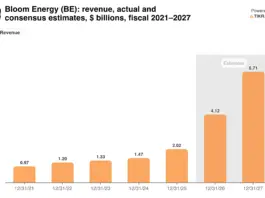
In FY 2025, revenue reached a little more than $2 billion, which represents a 37% increase compared to the prior year. Despite this top-line growth, the company reported a net loss of approximately $88 million for the period. This resulted in a wider net margin of negative 4.4%, a metric that measures how much of each dollar of revenue is kept as profit after all expenses are paid.
As of its December 2025 balance sheet, the debt-to-equity ratio was nearly 3.9x, which compares total debt to shareholder equity to see how much a company relies on borrowing. The so-called current ratio, which measures the ability to pay short-term debts with assets that can be converted to cash within a year, was roughly 6.0x. For the fiscal year, free cash flow reached about $57.2 million, representing the cash remaining after paying for operations and capital expenditures.
The case for NextEra Energy
NextEra Energy operates through two primary segments: Florida Power & Light and NextEra Energy Resources. Florida Power & Light is a massive regulated utility serving approximately 6 million accounts in Florida, providing a steady foundation of revenue. This scale makes it a prominent name among electric utility stocks for those seeking renewable energy exposure.
In FY 2025, revenue reached close to $27.5 billion, which represents an 11% increase over the previous year. Net income for the year was roughly $6.8 billion, resulting in a net margin of nearly 25%. In its latest annual report, filed in 2026, the company highlighted the consistent demand for its utility services and its expansion into battery storage solutions.
As of the December 2025 balance sheet, the debt-to-equity ratio was approximately 1.8x. The current ratio, which compares short-term assets to short-term liabilities, was close to 0.6x, while free cash flow reached nearly $3.2 billion. Free cash flow is the cash a company generates after accounting for the money spent on maintaining or expanding its physical assets.
Risk profile comparison
Bloom Energy is currently defending against multiple securities class action lawsuits while facing scrutiny regarding supply chain practices and Chinese scandium sourcing. Significant project execution risks exist due to long sales cycles and a reliance on a limited number of suppliers. Furthermore, maintaining market confidence in its liquidity remains a concern given its history of reporting net losses.
NextEra Energy faces risks from severe weather events like hurricanes and adverse regulatory decisions that could impact its utility operations in Florida. The company also handles integration and execution risks related to its large-scale acquisition of Dominion Energy Inc (D -0.96%). Finally, the use of artificial intelligence technologies introduces potential vulnerabilities regarding cybersecurity and model inaccuracy.
Valuation comparison
NextEra Energy appears to be the more conservatively valued option because it features a lower Forward P/E and P/S ratio than its peer.
MetricBloom EnergyNextEra EnergyForward P/E56.8×18.3xP/S ratio25.1×5.8x
Valuation metrics sourced from Financial Modeling Prep (FMP) and may differ from other data providers.
Which stock would I buy in 2026?
NextEra Energy is a regulated utility and one of the world’s largest operators of renewable energy assets, with about one-third of its 4 gigawatts (GW) of generation capacity coming from wind and solar. As energy demand continues to soar, NextEra is well-suited to meet it. Its FPL subsidiary added more than 90,000 customers in the second quarter compared to the prior year’s comparable quarter. The typical FPL residential bill remains approximately 30% below the national average and is projected to increase by only 2% annually on average through the end of the decade.
Energy storage is also a growth area for the company. Battery storage represented 2 GW of additions this quarter. NextEra can build battery storage as a stand-alone project or co-locate storage across the company’s existing renewable sites. NextEra can also develop batteries as grid solutions, and can expand 4 hour batteries to 8 hours at its existing storage sites to accommodate customer growth.
All of that is helping the business raise sales to more than $31 billion in fiscal 2026, according to Wall Street analyst consensus. Net income should rise more than 25% to close to $8.8 billion. Free cash flow continues to be a problem, with FCF projected at negative $19 billion.
Bloom Energy’s core product is its Energy Server, a stand-alone power source for commercial and industrial customers. The Energy Server is based on solid oxide fuel cell technology and runs on natural gas, biogas, or hydrogen.</
Source: www.fool.com — article syndicated from the publisher’s feed; all rights remain with the original publisher.