
Key Takeaways
- Vistra closed down 14% on Wednesday, at a new 52-week low, after Texas elected a governor who campaigned on pausing new data centers. KeyBanc downgraded the stock the same day.
- Before the vote, analysts expected Vistra’s normalized EPS to jump more than 80% in 2026, and almost all of its 2026 and 2027 output was already hedged. So far, the selloff has hit what investors pay, not what analysts expect.
- The real exposure is 2028 and unsigned Texas deals, a risk Constellation Energy and NRG Energy also carry into their reports next week.
- GE Vernova’s gas backlog and slot reservations were still growing through September, though more slowly, so Friday’s 2027 outlook is the first real read on what changed.
Vistra (VST) closed down 14% at $120.29 on Wednesday, Nov. 4, a new 52-week low, after Texas elected Democrat Gina Hinojosa governor on a promise to pause new data centers. KeyBanc downgraded the stock the same day.
The selloff spread across the AI power trade. Constellation Energy (CEG), which owns Texas plants through Calpine, fell 8% in morning trading. NRG Energy (NRG), the other big Texas generator and power retailer, takes the same question into its report next week. And on Oct. 28, GE Vernova (GEV) said power producers were still signing up for new gas turbines.
Vistra reports third-quarter results before the open on Friday, Nov. 6. It’s management’s first chance to show how much of its earnings depends on Texas data centers.
Texas Voted for a Slower Build
“When I am governor, I will issue a moratorium on any new data centers and any approvals for any data centers until we can pass laws to protect Texans,” Hinojosa said late in the campaign. She is the first Democrat elected Texas governor since 1990, and she takes office in January.
Texas already has a pause. On Aug. 3, Gov. Greg Abbott froze approvals for data centers seeking grid connections until ERCOT, the state’s grid operator, completes an audit. He said ERCOT was weighing about 474 GW of requests, roughly 90% of them data centers. The vote makes it likelier that a temporary freeze becomes a longer one, written into law.
KeyBanc’s Sophie Karp cut Vistra to Sector Weight from Overweight and removed the firm’s price target. She said a Democratic sweep in Texas “will come as a negative surprise to investors,” with Vistra the most exposed.
TIKR Tracks 23 Analysts on Vistra. How Many Say “Buy”?
See the full breakdown of Buy, Hold, and Sell ratings on Vistra, along with Wall Street’s revenue and earnings estimates, all in one place. More than 500,000 investors use TIKR to research stocks like this one. See Vistra’s Analyst Ratings
Analysts Still Expect a Big 2026 for Vistra
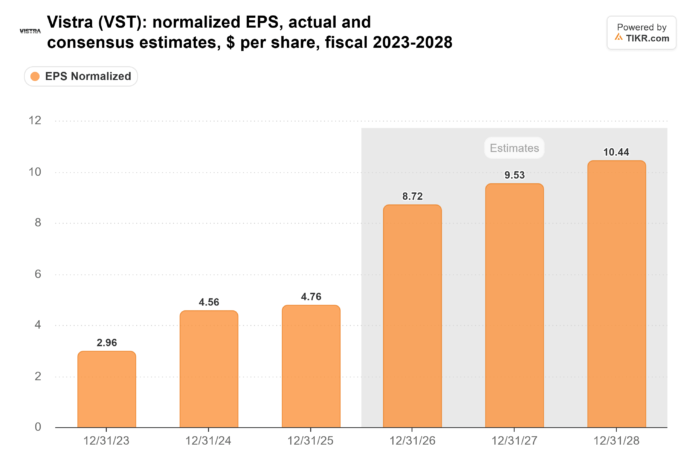
On Oct. 28, the last read before the vote, analysts expected Vistra’s normalized EPS to jump from $4.76 in 2025 to $8.72 in 2026, then $9.53 in 2027 and $10.44 in 2028:
VST Normalized EPS Actuals and Estimates: 2023-2028 (TIKR)
Most of that comes from power Vistra has already sold. As of Aug. 3, it had hedged about 100% of its expected 2026 output and 94% of 2027’s, so I don’t expect the election alone to pull those estimates down much. 2028 is another story, at only about 72% hedged.
Texas generation also isn’t Vistra’s biggest segment anymore. In the first half of 2026, the East segment earned $1.44 billion of adjusted EBITDA, against $897 million from Texas. Vistra also took over 5,496 MW of Cogentrix gas plants on Oct. 30, and only one of them, the 583 MW Altura plant, is in Texas.
So investors cut what they’ll pay for those earnings instead. Vistra traded at 13x forward earnings on Nov. 2, already below its five-year average of 15x:
VST Stock NTM P/E: 5-Year (TIKR)
Wednesday’s drop took it to about 12x.
What Vistra Has to Show on Friday
Management’s 2027 adjusted EBITDA range is $7.4 billion to $7.8 billion, and the CFO said in August it was trending toward the low end. That range leaves out about $700 million from Cogentrix and the Meta nuclear deal. Add them back and the low end is about $8.1 billion, a little above the $7.96 billion analysts expected on Nov. 3. A 2027 figure of $8.1 billion or more would tell us the vote hasn’t touched next year.
Then there’s Texas nuclear. Amazon has 1,200 MW of Comanche Peak under a 20-year deal, with delivery starting in late 2027. In February, CEO Jim Burke said Vistra could contract up to 3.2 GW more across Beaver Valley and Comanche Peak. Investors will want to hear whether the Texas talks survive a governor who wants new data centers paused.
The third quarter carries the Texas summer, and free cash flow came in just over $1 billion in the third quarter of both 2024 and 2025:
VST Quarterly Free Cash Flow: Q3 2024-Q2 2026 (TIKR)
Three Other Stocks Hang on Vistra’s Call
NRG has the most riding on an unsigned Texas deal. In August, it said it had aligned with a hyperscaler on principal commercial terms for a 1.2 GW Texas gas plant, still subject to final documentation. Its Texas segment earned $381 million of adjusted EBITDA in the second quarter, down from $512 million a year earlier. That’s the kind of project a moratorium could slow, so I’ll watch whether NRG still expects to sign it and keeps its 2026 adjusted EPS guidance of $7.90 to $9.90.
Constellation’s exposure is narrower by KeyBanc’s read, and its 3,590 MW Google deal and its Amazon deal still stand. Management has promised a second look at its $11.50 to $12.50 guidance for 2026.
GE Vernova’s gas backlog and slot reservations grew to 122 GW from 116 GW in the third quarter. But that 6 GW gain followed a 16 GW jump in the second quarter, so demand was already cooling before the vote.
Hold 2027, and the Drop Looks Overdone
Data center cancellations were climbing before anyone voted, too. Heatmap Pro data
Source: www.tikr.com — article syndicated from the publisher’s feed; all rights remain with the original publisher.

